KEY POINTS
-
The Galveston Bay Barrier System, also known as the “Ike Dike,” is moving forward with preliminary engineering and design, representing a possible generational opportunity for the construction industry.
-
Estimated at $31 billion within a broader $57 billion Coastal Texas Project, the initiative faces funding challenges and will require federal and state investment.
-
While designed to protect against Category 2 hurricanes, the project has sparked debate over the long-term adequacy of hard infrastructure versus nature-based coastal defenses.
A long-discussed coastal megaproject designed to shield the Houston–Galveston, Texas region from devastating hurricane storm surges has moved closer to reality. According to Houston Public Media, local officials have formally authorized preliminary engineering and design for the Galveston Bay Barrier System, widely known as the “Ike Dike.”
Earlier this year, the Gulf Coast Protection District board voted unanimously to authorize contractors to begin early design work on the barrier. This decision marks the first step toward constructing what could become one of the largest civil construction projects in the world.
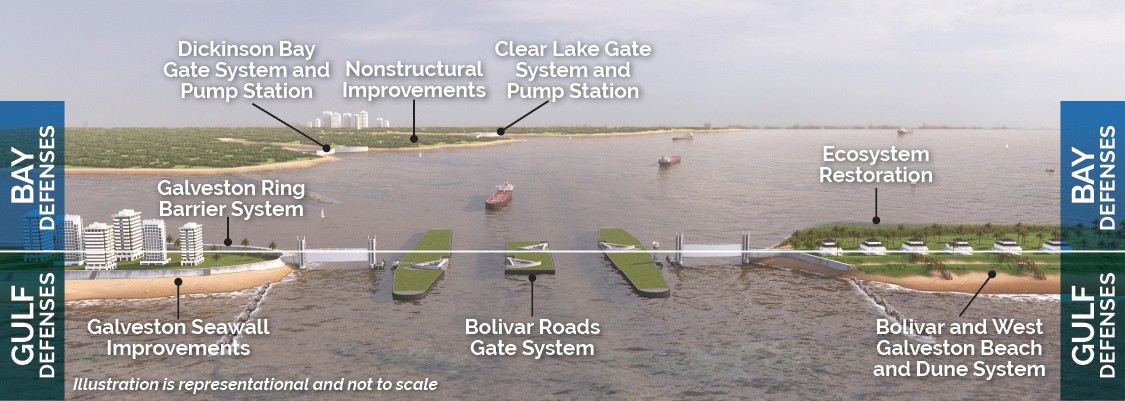
A conceptual rendering of the coastal protection project that shows multiple lines of defense from coastal storm surge in Galveston Bay. Image: Coastal Texas Project
A $31 Billion Barrier in a Coastal Defense Network
The Galveston Bay Barrier System serves as the anchor for the Coastal Texas Project, a comprehensive initiative encompassing seawalls, navigable gates, dunes, ecosystem restoration, and beach nourishment across the state’s 367-mile Gulf Coast.
While the Coastal Texas Project was authorized initially at roughly $34 billion in 2022, inflation has increased the estimated overall cost to approximately $57 billion. The barrier system itself accounts for the majority of this investment, with just over $31 billion allocated to its construction.
Plans call for an 82-foot-tall, two-mile-long gate structure spanning the mouth of Galveston Bay between Galveston Island and the Bolivar Peninsula.
Historic Context, Over a Century of Hurricanes
For more than a century, hurricanes have repeatedly tested the resilience of the people and structures on the Texas coast.
The Great Storm of 1900 devastated Galveston and claimed thousands of lives, while more recent storms, such as Hurricane Ike in 2008, caused enormous damage.
Ike alone led to over $30 billion in storm-related losses along the upper Texas coast, severely impacting the Galveston Bay area, erasing much of the Bolivar Peninsula, and leaving a debris line stretching for miles.
The storm also disrupted core economic sectors, including industrial activity and jobs, oil and gas, and supply chains. FEMA estimated the economic impact of Hurricane Ike at nearly $150 billion.
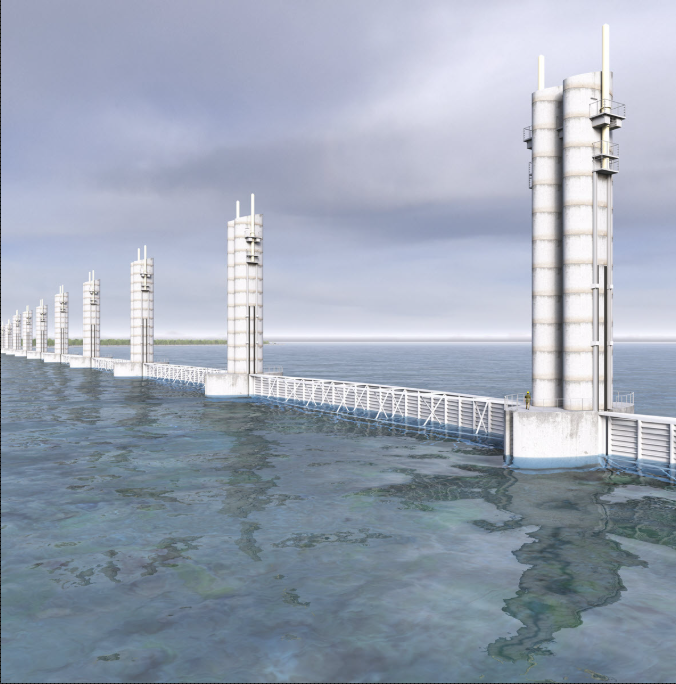
A lift gate rendering. The gate is a component of the coastal protection project that incorporates multiple lines of defense from coastal storm surge in Galveston Bay. Image: Coastal Texas Project
Possible Multi-Decade Project
The U.S. Army Corps of Engineers, working in partnership with the Texas General Land Office and the Gulf Coast Protection District, anticipates that the design and construction process will span at least 20 years. Jim Blackburn, a Houston environmental lawyer and Rice University professor who consults for the protection district, has described the effort as potentially the largest engineering project in the world.
Design Contracts Awarded, Work Getting Underway
Technical work is underway following the award of two master design contracts in November 2025. Jacobs Engineering Group Inc. was selected to lead the design of the two-mile-long gate system. At the same time, HDR Inc. will oversee the design of the associated beach and dune systems for the Bolivar Peninsula and West Galveston beaches.
A January 2026 vote authorized these firms to begin preliminary engineering tasks, moving the project from concept to technical execution after more than a decade of studies that followed Hurricane Ike’s destructive landfall in 2008.
Funding Gap Clouds Long-Term Delivery
Despite notable design progress, long-term financing remains a critical challenge. The $57 billion price tag underscores the unprecedented scale and complexity of the effort.
While the Texas Legislature has appropriated $950 million to the protection district for coastal work, only $220 million is designated specifically for the Coastal Texas Project, including the barrier system and ecosystem restoration.
Federal contributions have been slower to materialize. The federal government, which is expected to cover 65% of the total cost, has provided $500,000 in 2024 and is scheduled to add another $5 million in early 2026. This remains far below the estimated $2 billion per year needed over the next two decades to keep the project on track.
Funding has emerged as a challenge, as federal dollars account for only a fraction of what is ultimately required. District officials note, however, that large-scale infrastructure projects are typically funded incrementally.
Engineering for Future Storms
Beyond financing, the project is under scrutiny for its design parameters. As a federal agency, the Army Corps analyzes projects over a 50-year planning horizon. This framing restricts the design standard to a “50-year storm”, an event with a 2% annual chance of occurring. As a result, the barrier is expected to provide protection roughly equivalent to that required for a Category 2 hurricane.
Critics argue that this approach may be insufficient given the frequency and severity of high-intensity storms. For example, Hurricane Ike, classified as a Category 2 storm when it struck in 2008, produced a storm surge comparable to that of a Category 4 event, resulting in nearly $30 billion in damage.
Hard Infrastructure Versus Nature-Based Protection
The project underscores an ongoing debate within the industry between “gray” (structural) and “green” (nature-based) approaches to coastal defense.
Galveston Bay is the seventh-largest estuary in the United States, supporting a diverse ecosystem that is vulnerable to sea-level rise, land subsidence, and development pressures.
Although the Coastal Texas Project allocates $3.18 billion for marsh restoration and oyster reef creation, this investment accounts for only about 10% of the overall cost of the barrier system itself.
Opponents of the barrier system have said that the approach relies too heavily on hard infrastructure.
Proponents of nature-based solutions argue that, without stabilizing coastal edges and adjusting development policies, large gate systems may provide only temporary relief against rising seas.
What’s Next
For the construction industry, the Ike Dike offers the potential to participate in what could be considered a once-in-a-generation megaproject. With multi-decade timelines and technically complex project scopes, ranging from massive marine structural work to extensive earthmoving for dune systems, it stands out as one of the industry’s more demanding and extensive forthcoming opportunities.
Although full funding has not yet been secured, the move from concept to engineering demonstrates that the Gulf Coast Protection District and the Army Corps are advancing the project. For contractors and industry decision-makers, this development warrants close monitoring as opportunities emerge.
Stay Connected
Stay connected with ConstructConnect News for construction industry news and construction market analysis to stay ahead of what’s building next.
About ConstructConnect
At ConstructConnect, our software solutions provide the information construction professionals need to start every project on a solid foundation. For more than 100 years, our insights and market intelligence have empowered commercial firms, manufacturers, trade contractors, and architects to make data-driven decisions and maximize productivity.
ConstructConnect is a business unit of Roper Technologies (Nasdaq: ROP), part of the Nasdaq 100, S&P 500, and Fortune 1000.
For more information, visit constructconnect.com