KEY POINTS
-
Arizona State University is launching one of the largest construction pushes in its history, with major academic, research, student-life, housing and athletics projects advancing across its main campuses.
-
The 2026 pipeline is led by a $200 million ASU Health building in downtown Phoenix, alongside big-ticket investments in the John S. McCain III Library and Museum, Bateman Physical Sciences Center and Desert Financial Arena.
-
Taken together, the projects show ASU’s push to expand research capacity, replace aging facilities and improve student and community spaces as the university positions itself for long-term growth.
Arizona State University (ASU) is embarking on one of the most ambitious construction programs in its history, with hundreds of millions of dollars in new academic, research, student-life and residential projects either underway or poised to begin across its four main campuses.
From a next-generation medical education hub in downtown Phoenix to a landmark museum honoring late Sen. John McCain, the projects are designed to accommodate growth, modernize aging facilities and strengthen the university’s role as a research and innovation leader.
Downtown Phoenix Health Project Leads ASU’s 2026 Construction Slate
The centerpiece of the 2026 slate is a new ASU Health building in the Bioscience Core innovation district in downtown Phoenix. Construction is scheduled to begin in July on the approximately 200,000-square-foot facility, with completion targeted before the fall 2028 semester.
The $200-million project will serve as the headquarters for ASU Health and house the John Shufeldt School of Medicine and Medical Engineering, the Health Observatory at ASU and the School of Technology for Public Health.
The multi-level building will feature traditional classrooms alongside virtual- and augmented-reality learning environments, health-care simulation and skills laboratories, medical technology innovation spaces, faculty offices, student support areas, a library and community gathering spaces.
“The unique thing about ASU Health is that the med school of the future is not defined. So, we’re trying to define that as the train is moving and the tracks are being laid,” explained Tim Smith, ASU’s vice-president for facilities development management. “A lot of it will be tech driven.”
The project is being paired with an $8-million renovation of the Mercado building, which will temporarily house ASU Health programs until the new facility opens.
Tempe Campus Projects Combine Civic, Residential and Research Upgrades
In Tempe, another signature project is preparing to move from planning to construction. The $187-million John S. McCain III Library and Museum will create a new civic landmark dedicated to the legacy of the late senator.
A groundbreaking took place earlier this year, with construction expected to begin in late spring. The 80,000-square-foot facility is scheduled for completion in fall 2028.
Designed by SHoP Architects, the building will include an immersive museum experience, a research library, café, lecture hall, event spaces and flexible gathering areas for both the university and the broader community. The facility will also house and digitize McCain’s extensive archives, which he donated to ASU in 2012.
Located on a former tuberculosis hospital site near Tempe Town Lake, the museum is envisioned as more than a traditional archive. University officials see it as a destination focused on leadership, democracy, public service and civic engagement.
On the Tempe campus, ASU is preparing to demolish Best, Irish and Hayden residence halls, structures dating from the 1940s and 1950s, and construct a new residential complex. The first phase will provide approximately 800 student beds by fall 2028 and will include a bookstore and campus marketplace.
Student-centered improvements are also moving forward at ASU’s Polytechnic campus, where a major renovation and expansion of the Student Union is expected to begin this summer.
The $66-million project will roughly double the size of the existing facility, transforming it into a more comprehensive campus hub for the more than 6,100 students who attend the Polytechnic campus.
Construction crews will renovate existing dining facilities and the bookstore while adding new lounges, classrooms and meeting spaces for student organizations. The project is expected to wrap up next summer.
Student-Life and Athletics Investments Extend the Buildout
Nearby, ASU is also preparing to construct its first-ever 3D-printed building. The 1,200-square-foot shade-and-market structure will serve students waiting at the campus shuttle stop.
Rather than relying on traditional construction methods, the project will use a large-scale construction printer that deposits layers of concrete according to a computer-generated design. Developed in partnership with dining provider Aramark, the structure will combine a small market with shaded waiting areas and serve as a showcase for emerging construction technology.
Meanwhile, one of the university’s largest ongoing renovation efforts is taking place at the Bateman Physical Sciences Center H-wing in Tempe.
The $115-million modernization project will continue through summer 2028 and is being carried out in phases to minimize disruption to academic programs. Much of the early work focuses on infrastructure systems hidden behind walls, including mechanical, electrical and plumbing upgrades.
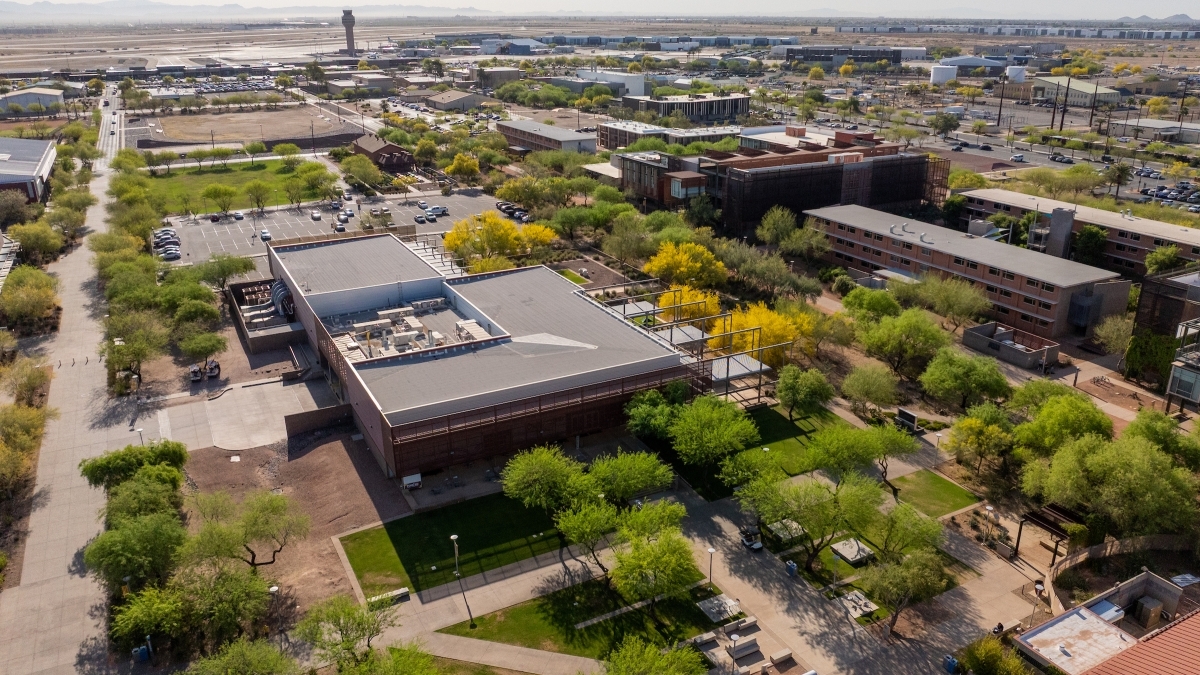
Student-centered improvements are moving forward at Arizona State University’s Polytechnic campus, where a major renovation and expansion of the Student Union is expected to begin this summer. The $66-million project will roughly double the size of the existing facility. Image: Arizona State University
The renovation will ultimately deliver 17 wet laboratories, 15 dry laboratories and 24 offices while replacing or upgrading aging building systems and improving accessibility and life-safety features. The university is also investing heavily in athletics and event facilities through a sweeping modernization of Desert Financial Arena.
The three-year, $100-million renovation will transform the 1974 arena, home to ASU basketball, volleyball, wrestling and gymnastics programs, into a modern entertainment venue.
Initial work will begin this summer and include replacing more than 700 lower-bowl seats with padded seating equipped with cupholders, along with the installation of 200 wider premium seats. Crews will also modernize technology infrastructure beneath the playing surface to support broadcasting, instant replay and multimedia systems.
Future phases will add new private-seating boxes, club seating, upgraded concessions, renovated locker rooms, improved restrooms, a new elevator, a replacement court and a large new video board.
Completion is scheduled for December 2029.
Stay Connected
Stay connected with ConstructConnect News for construction industry news and construction market analysis to stay ahead of what’s building next.
About ConstructConnect
At ConstructConnect, our software solutions provide the information that construction professionals need to start every project on a solid foundation. For more than 100 years, our keen insights and market intelligence have empowered commercial firms, building product manufacturers, trade contractors, and architects to make data-driven decisions, streamline preconstruction workflows, and maximize their productivity. Our newest offerings—including our comprehensive, AI-assisted software—help our clients find, bid on, and win more projects.
ConstructConnect operates as a business unit of Roper Technologies (Nasdaq: ROP), a constituent of the Nasdaq 100, S&P 500, and Fortune 1000.
For more information, visit constructconnect.com

.jpg?width=180&height=180&name=Grant%20Cameron%20(1).jpg)